

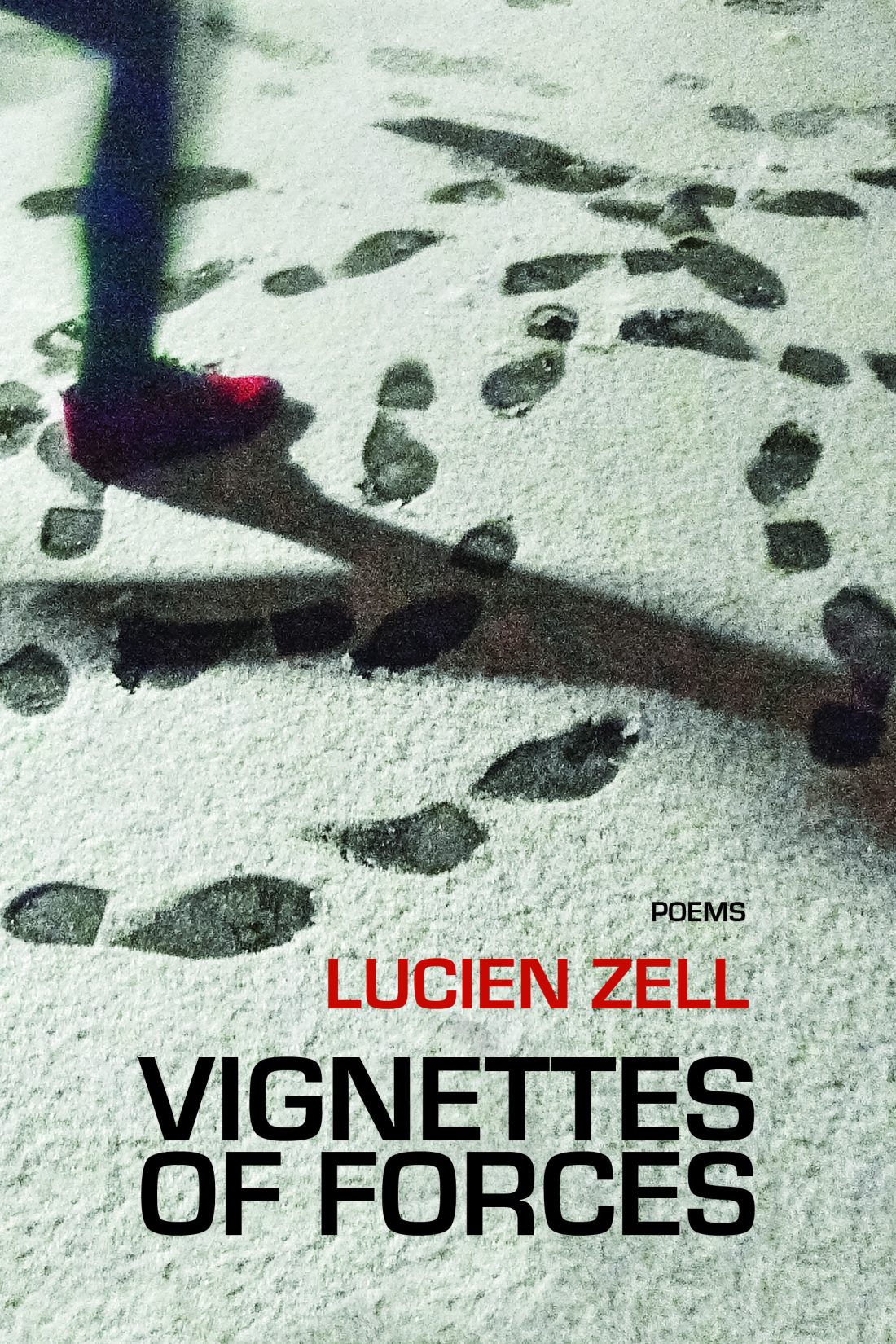
In reading Lucien Zell’s Vignettes of Forces, we have access to all the conventions that could guide our understanding of the poems. Personification and anthropomorphism will immediately present themselves, but neither of these terms will help you. Such obvious lines of interpretation do not work in reading Zell’s poetry because he is always hiding something in the open. I have learned from experience that Lucien Zell’s poetry always has much more going on than what first appears. The playful and at times flippant language and flow of the poems is not a characteristic of simplicity or ease. The play of the language is more of a dance, and allowing ourselves to be carried off in the dance will open the way to the real gifts these poems have to offer. However, like any dance, we need to hear the music and find the rhythm, and this is the genuinely exciting part of reading Lucien Zell’s poetry.
“Vignette of Soul” is a fine example wherein “Soul,” we discover, has fallen in the world and is now driving a taxi, scraping by on Social Security, and doing his best to support his photography. Soul, we are told is a storyteller, and we are given an example of one of the stand-out stories as an example. This story recounts the time Soul was propositioned by a woman on her way home from church. All this is well enough, and we could leave it at this, allowing ourselves to make whatever associations and inferences we choose with respect to the soul, church, and a woman making a proposition that may or may not be appropriate. However, it is precisely at this point in the poem that the language spins us off. The line breaks, and the twisting of consonants move us forward and jostle us around: “Apparently,/ the minister’s sermon that morning (on the Res-/ erection) had been particularly rousing. The river purled by.” The “R’s” dance around within the words, the breaks dip and twist between the pause at the comma and line break, and, most importantly, the break with “Res” and “-erection.” All this against a purling river, itself a steadily rolling and uncertain movement that only forms a dim background to the action. While on the one hand, the poem enacts the innuendo of the poem in linguistic play, on the other hand, the poem leads us out of the obvious and off in a direction that has no clear boundary or end. It all comes off quite clear then fades into a background that is indistinct, just like a visual vignette, the kind of thing kept in a locket or a small frame.
The visual vignette struck me as just as important as the literary vignette in approaching these poems because these are poems of words and ideas, or images, if you will. It seems only logical that the word and idea, “vignette,” should receive as much attention as “Soul” or “Grace” or “Death.” A fine example of how to approach the issue of the vignette itself is “Vignette of Humor” in which the poem explains that “Most performers/ can’t quite figure out how not to perform/ and still perform.” There is a stanza break between “perform” and “still perform” so as to perform the performance of a commentary on the performance of performance (I apologize. I know that is confusing). This could be simplified with the old saying, “funny people don’t tell jokes,” but the issue remains opaque. These moments come to us again and again throughout Vignettes of Forces because the vignette always fades away into something beyond the image. Thus, Zell’s poems grasp the problem that plagues too many people who attempt humor and fail. They do not get the idea that to be really funny, you need to perform as if the funny part is not funny at all, and you need to do this with the dead earnestness of one who is not performing, just like the poem we are reading. The trick is in the absence of the thing. To present a compelling and powerful vignette, one needs to write as if the image on display is fading away from the reader, as if the absence of the image is the thing. This is Zell’s great accomplishment in these poems. While the poetic mastery of language takes center stage, the most powerful feature of the poem is always just disappearing from sight, just beyond full comprehension.
Nearly all the vignettes offer fireworks of one sort or another. There are innocent jokes and dirty jokes. There are bad words, alcohol, and drugs. There is plenty of sex and wild adventures after too many drinks. Still, the magic of the poetry is such that amid these obvious escapades, something else is always working its way through the lines, line breaks, and fragmented words. Thus, we need to look into and beyond the playfulness for something more pressing. In “Vignette of Loneliness” we find familiar tropes amid the imagery of jazz and slick movement. Loneliness is a female in Zell’s imagination, and “She has charm,” but Zell is quick to stop here and explain: “She’s got/ a kind of inner glow. A kind of soul.” While it would be easy to read this as more of the idea of soul which aligns with the musical imagery of the opening stanza, there is something more to the word “soul” at about this, the dead middle of the poem, in which the “inner glow” itself is captured within the dead center of the line. She has soul, in fact, she is a soul that illuminates from somewhere inside because what is loneliness but those states when our own mind shines its full light on our own souls; those moments when the scrutiny of the heart and soul are turned completely around on us, and even amid the crowd, we are all there is to see. That is the agony of loneliness, which is why she is so seductive. This is why “She plays so hot” that “fears melt” because anything we might fear is dwarfed by the enormity of our own sense of self. This seems to be the power and beauty of Zell’s poetry. What appears simple and easy is not, and what can come off as a playful riff on an idea is in fact the image of an idea that fades into a background loaded with far more than what first appears.
The collection is set apart in sections. Each section provides a frame of sorts for the next set of vignettes, and if we have learned anything from the leading smarties of the last half-century, we know we need to pay at least as much attention to the frame as we do the picture. I will choose the final section, Section V, which spoke to me personally with the poem “Bus Stop Looks at Man.” As one who spent more than a decade sprinting toward, standing at, freezing in front of, and otherwise letting life pass me by at bus stops, this poem seemed pointed directed directly at me. The most obvious thing we note about these frame poems is that they are not vignettes, or they are not, at least, named vignettes. They direct us toward the center of the image by removing themselves in their clear presence. If the vignette fades to indistinct glows, the frame, no matter how ornate, falls away as the gaze move towards the main image. Yet, in “Bus Stop Looks at Man,” we are pulled toward the frame itself in which “Rushed and ephemeral beings, they rush/ to stand at me and wait.” No longer a speaker reminiscing on a personified idea, here we have the voice of the object. We come to know what it sees. We, the humans, are the rushed and ephemeral beings who are ephemeral in our time at the bus stop and in our time as beings. We hurry up and wait, conditioned and taught to behave by an inanimate object, the bus stop. It may not even be an object. Some bus stops are simply points along a line. In any case, we become the mute objects who are brought to heel by the thing. Like all the frame poems, this one stands out for a host of reasons, and in the case of “Bus Stop Looks at Man,” what stands out most prominently is that this poem articulates the central issue: “There’s a secret stillness/ at the heart of every journey” that is arrested in the impossible speed of thought that is “faster than the speed of light” as the bus stop captures all the ephemeral beings in its empty space. Here, in this isolated and nearly meaningless space, all comes to a stand-still. All ephemeral beings, “Busy in their/ crowded solitudes” are made to stop, wait, and do nothing but wait. Lucien Zell creates these moments like no other. Having read some of his other work, I have come to look for these moments in his poetry—moments in which the play, dance, and even trickery of the language arrests all movement and all intellection in an empty presence that is completely filled with the presence of absence.
I wonder if Vignettes of Forces offers a stepping stone from Frances Ponge as the poetry of things, the poetry of all that never speaks but communicates and bears on us at all times in one way or another. Where Ponge gave voice to the lowly pebble, worn from vast rocks by the force of the ocean, Zell speaks for the ocean whose truth “is more solid” than the stone or the pebble because its “truth is made of rage/ and flow that rocks can’t fathom;” here is the Truth “that shapes the truth of rocks” (“Ocean Truth.”). Whereas Ponge seemed to want to assign a definite and intelligible rhetoric to things, Zell is intent on hearing the songs of things and recounting them in the form of the vignette as if to show us that however much things speak, their words are fading into something that floats out beyond words. The vignette form always suggests that there is much more to the story, and that the author is only giving us a short sketch. In this way, it seems to me that these poems, as we find in all Zell’s work, serve as an invitation more than a description, more than a personification or anthropomorphism. Vignettes of Forces is an invitation to us to do the work, to meditate on all this. There is even a “Vignette of Work” in which “work/ has never had to work a day in his life.” This is because “Your real work is not what gives you your food—/ it’s what gives you your hunger.” This is the real work of Vignettes of Forces, and, thankfully, that work is ours.
You can watch Lucien’s Zell’s collaboration with the Hungarian world music band Earthjam performing “Imagi-Nation” at this link:
https://www.youtube.com/watch?v=Csol50Sa2Ro.
You can also watch poem-videos of Zell’s “The Ivy” and his peace song “Shalom is Our Home” at these links:
https://www.youtube.com/watch?v=MesUh3UhshY.
https://www.youtube.com/watch?v=Z3u5H7I4pWc.
